


Afternoon Tea with K Britt: The Housing Hustle—Discrimination, Displacement, and the Quiet Theft of Black Futures

June 23, 2026

Variety News & Information

🌆The New Great Migration: Why Black Families
Are Leaving America’s Cities Again
A Quiet Migration Hidden in Plain Sight
Across the nation, Black families are quietly leaving major cities in a pattern that mirrors the Great Migration of the early twentieth century, yet this time the movement is driven by a different kind of pressure. Instead of fleeing racial terror in the South, families are now escaping the economic and psychological strain created by discriminatory housing markets, rising rents, and the erosion of community stability. As noted in the Atlantic article link below, the Black population in America’s largest cities has dropped from 40% to 24% over the past fifty years. This decline is not simply demographic; it reflects a deeper emotional fatigue. Families are leaving neighborhoods where they once felt rooted because the cost of staying—financially, psychologically, and socially—has become too high to bear. Why Are Black Families Leaving Cities? - The Atlantic

The Psychological Weight of Forced Mobility
From a psychological perspective, this exodus represents what scholars describe as forced mobility stress, a chronic strain that emerges when families are pushed out of familiar environments by forces beyond their control. Housing discrimination, as documented in the referenced NBER study, plays a central role in this stress. When African American renters receive fewer responses to housing inquiries, they internalize a message that their presence is unwelcome or undervalued. Over time, this repeated rejection erodes trust in institutions and creates a sense of instability that affects emotional well‑being. Families begin to associate their cities not with opportunity, but with exclusion, prompting them to seek refuge in places where they hope to rebuild a sense of belonging. w29516.pdf
The Cost of Displacement on Black Futures
The consequences of this displacement extend far beyond individual households. As Black families leave cities, political power becomes diluted, community networks weaken, and cultural continuity is disrupted. The National Urban League’s State of Black America report warns that Black progress is stagnating, and demographic shifts are a major factor. When families are scattered, their collective influence diminishes, making it harder to advocate for equitable policies or resist discriminatory practices. This migration is not merely a movement of people; it is a movement of history, identity, and political voice. Echo News TV LLC recognizes that naming this crisis is essential, because silence only strengthens the systems that benefit from Black displacement. Black Americans' significant economic and civil rights progress threatened, report says | AP News

🌺The Foster‑Care Red Flag: Why Black Children
Keep Disappearing Into the System
A System That Claims to Protect but Often Harms
The foster‑care system in the United States has long been presented as a protective institution, yet for many Black American families, it functions as a source of trauma rather than safety. The USC Center for Health Journalism report reveals the devastating reality: Black children are removed from their homes at disproportionate rates and often experience more harm inside the system than they did before intervention. The story of the young girl who endured repeated abuse in both her birth home and foster placements illustrates a tragic pattern, per the USC article titled "Black advocates fight for justice in foster care". Instead of receiving healing and stability, many Black children encounter environments that deepen their trauma. This contradiction—between the system’s stated mission and its actual outcomes—creates a moral and psychological crisis that demands public attention. Black advocates fight for justice in foster care | USC Center for Health Journalism

Trauma Misinterpreted as Misbehavior
Psychologically, the behaviors often labeled as “defiance” or “aggression” in Black foster youth are frequently symptoms of unresolved trauma. As the referenced report explains, children who have experienced sexual abuse, neglect, or instability may act out because they lack the emotional tools to process their pain. Yet instead of receiving trauma‑informed care, these children are often placed in homes where foster parents are not fully informed of their histories. This lack of transparency leads to misunderstandings that can result in placement breakdowns, further reinforcing the child’s belief that they are unwanted or unworthy. Each move compounds the psychological damage, creating a cycle of instability that becomes increasingly difficult to interrupt.
Systemic Racism and the Erosion of Black Family Stability
The overrepresentation of Black children in foster care cannot be understood without acknowledging the systemic racism embedded in child welfare policies. Poverty, housing instability, and limited access to resources are often interpreted as parental neglect, even when families are doing their best under oppressive conditions. Per the referenced NBER housing discrimination study, Black families face barriers long before CPS becomes involved. When discriminatory housing practices push families into unstable living situations, CPS often steps in—not to support, but to separate. This transforms structural inequality into family fragmentation. The long‑term psychological impact is profound: children lose their cultural anchors, parents lose their authority, and communities lose their future. Echo News TV LLC is committed to exposing this crisis because the well‑being of Black children is inseparable from the well‑being of Black America.

🏚️The Housing Crisis Nobody Wants to Name
A Crisis Hidden Behind Polite Language
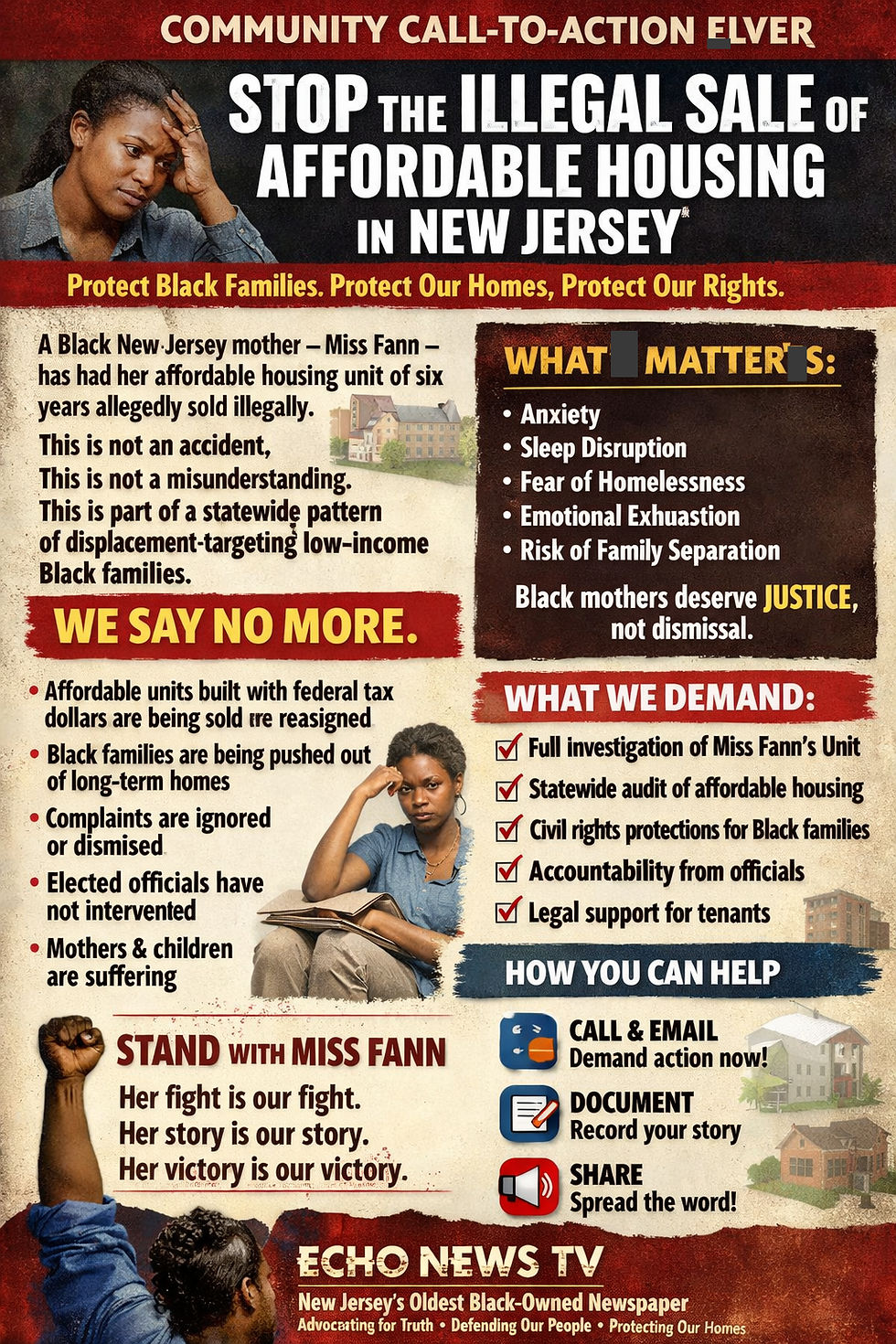
Across the United States, a quiet but devastating housing crisis is reshaping the lives of Black American families. Especially in New Jersey. While policymakers often describe the issue in neutral terms—“market pressures,” “urban revitalization,” or “neighborhood redevelopment”—the lived reality is far more painful. The cited NBER study reveals that African American renters receive significantly fewer responses from property managers, even when their inquiries are identical to those of white renters. This subtle but persistent discrimination creates a psychological environment in which Black families must navigate uncertainty, rejection, and exclusion at every stage of the housing search. The crisis is not simply economic; it is emotional, destabilizing, and deeply personal. Families are not just losing homes—they are losing the sense of safety and dignity that stable housing provides. w29516.pdf https://www.echonewstv.com/post/the-elevator-to-nowhere-inside-rpm-management-s-neglect-broken-promises-the-high-cost-of-af
The Psychological Toll of Structural Exclusion
From a psychological standpoint, discriminatory housing practices create a form of chronic stress that affects both mental health and daily functioning. When families repeatedly encounter barriers—ignored inquiries, unexplained denials, or sudden rent increases—they internalize a message that their presence is unwelcome. This experience aligns with what psychologists describe as racialized environmental stress, a condition in which individuals must constantly adapt to systems that treat them as outsiders. Such as, for example, vulnerable sub-populations of Black North Americans and North American Sovereign Nations who experience poverty for the most part. Over time, this stress can lead to anxiety, depression, and a diminished sense of agency. The cited NBER study confirms that discrimination is not random but patterned, predictable, and widespread. For Black families, this means that every attempt to secure housing becomes a psychological negotiation between hope and the expectation of rejection. https://www.echonewstv.com/post/echo-news-tv-advocacy-report-stolen-homes-stolen-peace-the-psychological-toll-of-new-jersey-s-aff
How Housing Instability Steals Black Futures
The consequences of this crisis extend far beyond the immediate struggle to find a place to live. Housing instability disrupts children’s education, weakens community networks, and erodes the political power of Black neighborhoods premeditatively. When families are forced to move frequently, children lose access to consistent schooling, supportive teachers, and stable peer relationships—factors that are essential for healthy psychological development. Adults, meanwhile, lose the ability to build equity, participate in local governance, or maintain long-term community ties. The National Urban League’s State of Black America report warns that Black progress is stagnating, and housing discrimination is a major contributor. By destabilizing Black families, the housing system quietly undermines economic mobility, civic participation, and generational continuity. Echo News TV LLC recognizes that naming this crisis is not only necessary—it is an act of protection for the future of Black America.

🧠The Mental Health Toll of Everyday Racism
The Invisible Weight Black Americans Carry Daily
Across the United States, Black Americans navigate a psychological landscape shaped by centuries of racial injustice, yet the emotional toll of this daily experience often goes unrecognized. Per the cited mental health report emphasizes that racism is not merely a social issue but a chronic psychological stressor that affects cognition, emotional regulation, and physical health. Everyday encounters—being followed in a store, dismissed by a doctor, or stereotyped in professional settings—accumulate into what psychologists call racial battle fatigue. This fatigue is not imagined; it is a measurable response to persistent discrimination. Over time, these experiences create a baseline of hypervigilance, where individuals must constantly anticipate bias, microaggressions, or outright hostility. This constant state of alertness drains emotional resources and shapes how Black Americans move through the world.

Misdiagnosis and the Failure of Traditional Mental Health Systems
The mental health system in the United States has historically failed to recognize the unique psychological experiences of Black Americans. Per the referenced report highlights that diagnostic tools such as the DSM‑5 often overlook the cultural and historical context necessary to understand Black mental health accurately. As a result, symptoms rooted in racial trauma—such as irritability, mistrust, or emotional withdrawal—are frequently misinterpreted as personality disorders or behavioral problems. This misdiagnosis not only leads to ineffective treatment but also reinforces harmful stereotypes about Black emotional expression. When clinicians lack cultural competence, they risk pathologizing normal responses to abnormal conditions. This disconnect between lived experience and clinical interpretation creates a barrier to healing, leaving many Black individuals feeling unseen, unheard, and misunderstood within the very systems meant to support them. Homepage | State of Black America
The Urgency of Naming Racism as a Mental Health Crisis
The psychological impact of racism is not an individual issue; it is a collective crisis that affects families, communities, and future generations. When Black Americans endure chronic stress without adequate support, the effects ripple outward—shaping parenting styles, educational outcomes, and community cohesion. The referenced research in today's article topics underscores that racism contributes to increased morbidity, higher rates of depression, and reduced access to quality care. These outcomes are not the result of personal failure but of systemic neglect. Naming racism as a mental health crisis is essential because it shifts responsibility from individuals to institutions. It demands that policymakers, clinicians, and educators acknowledge the structural forces that shape Black well‑being. Echo News TV LLC recognizes that healing begins with truth‑telling, and addressing the mental health toll of racism is a necessary step toward building a more just and psychologically healthy society.

🗳️The Political Freeze: Why Black American Progress
Has Stalled for 40 Years
Progress Made, Progress Stalled
Over the past six decades, Black Americans have made undeniable strides in education, civic participation, and economic mobility. Yet, as the National Urban League’s State of Black America report makes clear, this progress has slowed dramatically, creating what can only be described as a political freeze. Despite increased voter registration and expanded representation in some sectors, the racial income gap has remained virtually unchanged for more than twenty years. This stagnation is not the result of apathy or lack of effort; it is the product of structural barriers that have evolved to appear race‑neutral while producing racially unequal outcomes. The psychological impact of this stalled progress is profound, as communities that have fought tirelessly for advancement now confront the emotional weight of seeing their efforts undermined by shifting political landscapes and policy rollbacks. https://www.echonewstv.com/post/the-confederacy-s-shadow-how-caste-thinking-cheap-labor-politics-and-forgotten-alliances-still

The Psychological Impact of Systemic Disenfranchisement
From a psychological perspective, the erosion of political gains creates a form of collective disillusionment that affects motivation, civic engagement, and community cohesion. When Black Americans witness legal challenges to civil rights protections, the dismantling of affirmative action, and the weakening of diversity initiatives, they internalize a message that their progress is conditional and easily reversed. This creates what psychologists refer to as learned political helplessness, a state in which individuals begin to doubt the effectiveness of their participation because the system repeatedly signals that their voices carry less weight. The referenced reports in this variety news report, Afternoon Tea with K Britt, highlight that Black voter turnout dropped significantly in recent years, not because of disinterest, but because of structural barriers and a growing sense that the political system is not designed to protect Black interests. This emotional fatigue is a predictable response to decades of systemic resistance to Black advancement. https://www.echonewstv.com/post/the-unholy-alliance-how-mafia-cartel-networks-and-sanctuary-politics-betrayed-america-s-children

How Displacement and Policy Backlash Undermine Black Futures
The political freeze cannot be separated from the broader social forces affecting Black communities, including housing discrimination, educational inequities, and the displacement of Black families from major cities. As families are pushed into suburban or rural areas with weaker political infrastructure, their collective voting power becomes diluted. This demographic shift, combined with targeted voter suppression efforts, creates a political environment in which Black citizens' influence is intentionally minimized. The National Urban League report warns that these trends threaten the future of Black economic and civil rights progress. When communities lose political power, they also lose access to resources, representation, and policy protections. The psychological consequences are generational: children grow up in environments where their communities are underrepresented, their schools underfunded, and their futures undervalued. Echo News TV LLC asserts that highlighting this political freeze is crucial, as the fight for Black progress must not proceed in silence. 📰 AFTERNOON TEA WITH K BRITT VARIETY NEWS June 13, 2026

🖋️ CLOSING EDITORIAL — What Black America Deserves Next
Black America deserves more than survival. They deserve stability, transparency, safety, and the full protection of their rights. Per the data referenced in this variety report, "In Concern of the Negro," while also addressing the plight of subpopulations in North Americans, with whom are also vulnerable to these devastating outcomes that are completely preventable makes one truth unmistakable: the crises facing Black North American families today are interconnected plus strategically enforced in the states that Black Americans live in for at least the last 50 years. Housing discrimination fuels foster‑care involvement. Foster‑care trauma fuels mental health disparities. Mental health disparities weaken political participation. Political stagnation reinforces discriminatory housing policies.
It is a cycle—one designed to:
Exhaust,
Displace, and
Silence.
But cycles can be broken.
Echo News TV LLC stands committed to exposing the systems that harm Black families and uplifting the truths that others avoid. Today’s Afternoon Tea with K Britt is not just a report; it is a call to awareness, a call to action, and a call to protect the future of Black America.


References:
The Atlantic – Why Are Black Families Leaving Cities? Why Are Black Families Leaving Cities? - The Atlantic
Cambridge University Press – The Great Migration & Residential Segregation
NBER – Racial Discrimination in the Rental Market w29516.pdf
The impact of racism on Black American mental health - The Lancet Psychiatry
USC Center for Health Journalism – Black Advocates Fight for Justice in Foster Care Black advocates fight for justice in foster care | USC Center for Health Journalism
National Urban League – State of Black America Report Black Americans' significant economic and civil rights progress threatened, report says | AP News



Comments