


Justice for Terry Haupt Jr.: A Community’s Demand for Truth Amid a Pattern of Statewide Neglect and Blame

May 28, 2026
LETTER FROM THE EDITOR — ECHO NEWS TV LLC
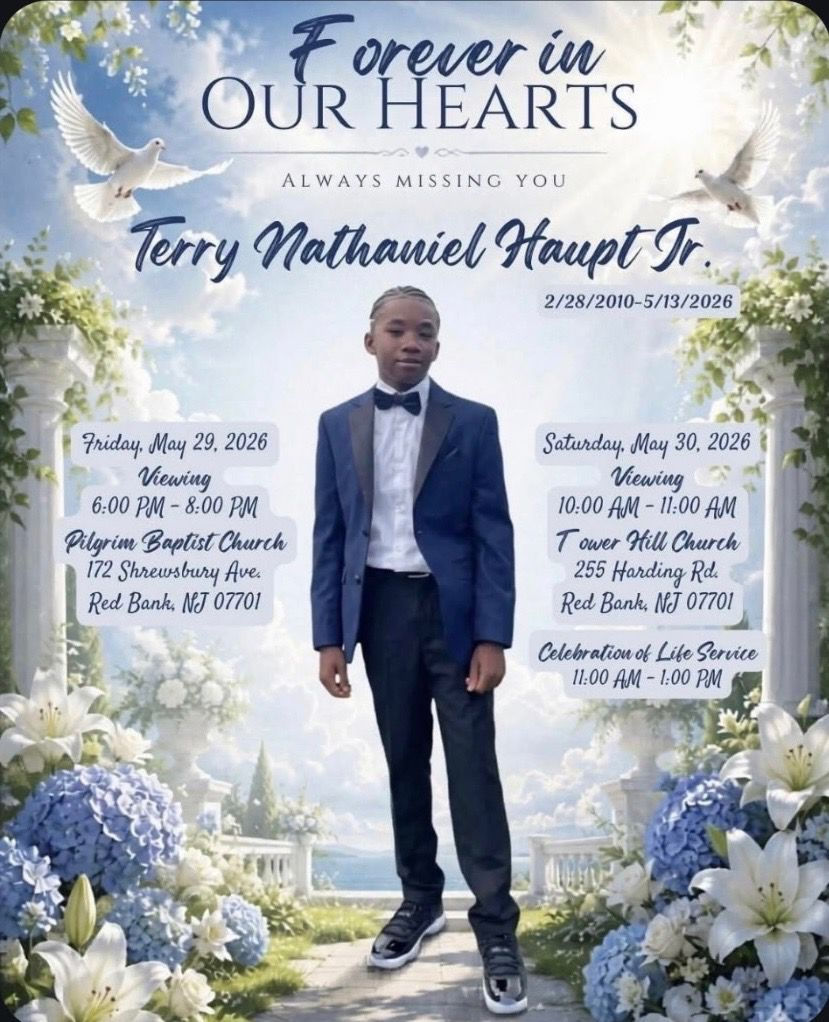
Red Bank, NJ - Terry Haupt Jr., a 16‑year‑old sophomore and student‑athlete, lost his life under deeply suspicious circumstances on the morning he was struck by an NJ Transit train at the Red Bank station. According to reporting, the train left Long Branch at 6:08 A.M. and reached Red Bank around 6:20 A.M., where Terry — simply walking home from the YMCA after a workout — was killed. No passengers or crew reported injuries. His family, now living with an unimaginable grief, deserves answers that have not yet been provided. https://www.echonewstv.com/post/the-confederacy-s-shadow-how-caste-thinking-cheap-labor-politics-and-forgotten-alliances-still

What disturbs me most is not only the tragedy itself, but the speed with which some voices — particularly on social media — rushed to blame Terry rather than question the circumstances. This reflexive victim‑blaming is not new. It is part of a long psychological and historical pattern in America: when a Black child dies under unclear or suspicious conditions, the burden of proof is placed on the child, not the system.
Psychologists call this phenomenon “attribution bias” — the tendency to blame individuals for harm done to them, especially when they belong to a marginalized group. Research published in Forbes (2023) highlights a related crisis: Black boys and young Black men are experiencing rising rates of trauma, depression, and suicide, often because they navigate environments where they are misjudged, misunderstood, or treated as threats rather than children. The article notes that Black boys are frequently denied emotional protection, empathy, and institutional care — a reality that shapes how their deaths are interpreted and too often dismissed.
Terry was not a reckless child. He was bright, alert, disciplined, and athletically gifted. He had dreams of playing college football. The idea that he would casually or intentionally put himself in harm’s way does not align with who he was — nor with the testimony of those who knew him.
We must ask harder questions.
Was Terry experiencing harassment at school, on the field, or at the YMCA?
Was he wearing headphones to block out negativity or derogatory comments?
Did he have conflicts with peers, acquaintances, or individuals who may have wished him harm?
Were there witnesses who have not yet come forward?
Were all surveillance cameras reviewed, and were all angles preserved?
Was the train operator interviewed thoroughly and independently?
Were environmental, mechanical, or procedural failures ruled out with transparency?
These are not accusations — they are the minimum questions any responsible investigation should pursue when a Black child dies under unclear circumstances.
New Jersey has seen multiple pedestrian train deaths in the past year alone — from Journal Square to Bergen County to River Edge to Bordentown. Each case raises concerns about safety protocols, visibility, operator response times, and investigative consistency. Yet when the victim is Black, the scrutiny too often shifts away from the system and onto the child.

This is why the Black community must remain vigilant. Red Bank is not just any town — it is a place where Black families built institutions, including the YMCA, whose legacy traces back to Anthony Bowen and the 19th‑century Black YMCA movement. These centers were created to protect, uplift, and empower Black youth in a society that refused to see their humanity. That history matters now more than ever.
Today, as demographics shift and political tensions rise, Black residents across New Jersey continue to face displacement, underinvestment, and institutional neglect. These pressures create environments where Black children are more vulnerable — not because of who they are, but because of the systems around them.
And when tragedy strikes, those same systems are too quick to absolve themselves.
As the oldest Black‑owned newspaper in New Jersey, Echo News TV LLC has both the right and the responsibility to demand a full, transparent, and independent investigation into the death of Terry Haupt Jr. His family deserves the truth. His community deserves the truth. And Terry — a child with a future, a name, and a purpose — deserves justice.
We will not allow his story to be reduced to speculation or blame.

We will not allow his memory to be overshadowed by narratives that have historically endangered Black youth.
We will not allow this case to fade into silence.
Terry Haupt Jr. mattered.
His life mattered.
And until the truth is known, we will continue to ask the questions others refuse to ask.
— Editor, Echo News TV LLC


References:
YMCA Black History Sources
African American Registry. (n.d.). History of Black YMCAs in the United States. African American Registry.
YMCA of Greater Monmouth County. (n.d.). History of the Red Bank YMCA. YMCA of Greater Monmouth County.
YMCA of South Hampton Roads. (n.d.). African American YMCA history and leadership. YMCA of South Hampton Roads.
Sociology & Structural Racism
Alexander, M. (2010). The new Jim Crow: Mass incarceration in the age of colorblindness. The New Press.
Feagin, J. R. (2013). The white racial frame: Centuries of racial framing and counter-framing. Routledge.
Victim‑Blaming, Bias, and Psychology:
Griffin, M., & Bernard, T. J. (2003). Anger, blame, and the victimization experience. Journal of Interpersonal Violence, 18(7), 773–788.
Swim, J. K., & Miller, D. L. (1999). White guilt: Its antecedents and consequences for attitudes toward affirmative action. Personality and Social Psychology Bulletin, 25(4), 500–514.
Williams, D. R., & Mohammed, S. A. (2009). Discrimination and racial disparities in health: Evidence and needed research. Journal of Behavioral Medicine, 32(1), 20–47.
Margareth Etienne and Richard H. McAdams, The Consequences and Constitutionality of Training Police to Blame Victims, 66 Wm. & Mary L. Rev. 467 (2024), https://scholarship.law.wm.edu/wmlr/vol66/iss2/4
Train Incident Sources
RLS Media. (2025, September 30). Pedestrian fatally struck by PATH train at Journal Square. RLS Media.
Daily Voice. (2025, February 26). Woman struck and killed by NJ Transit Port Jervis Line train near Rutherford Station. Daily Voice.
Local Crash Reports. (2025, August 15). Pedestrian struck by Pascack Valley Line train near New Bridge Landing Station. LocalCrashReports.com.
6ABC Action News. (2025, October 8). Trespasser fatally struck by River Line train near Bordentown Station. 6ABC Action News.
Unheard Voices. (2026, May 16). [Article on the death of Terry Haupt Jr.] Unheard Voices.
TAPinto Red Bank. (2026). Moving tribute read for Terry Haupt, Red Bank High School student accidentally killed in train accident. TAPinto.
Migration & Demographic Data
Migration Policy Institute. (2023). Frequently requested statistics on immigrants and immigration in the United States. MigrationPolicy.org.
Caste Thinking Racism in Spanish Speaking Countries & Stats
de la Riva Lopez, E. M. (n.d.). Anti-Blackness and Colorism in Mexico. Distinguished Professor of Psychology, Oakton College.
Moreno Figueroa M. G. (2010) Distributed intensities: Whiteness, mestizaje and the logics of Mexican racism. Ethnicities 10(3): 387–401.


Comments